
 RSS Feed
The California housing market is known for being competitive and expensive. But don't lose hope just yet! While there are challenges, there are also opportunities. As of January 2025, things are a bit mixed, with elevated mortgage rates impacting sales but prices still showing overall year-over-year growth. Let's dive deeper into the details to help you navigate this complex terrain.
California Housing Market: A Realistic Look at What's Happening
A January Snapshot: Sales Dip, Prices Still Up
The latest report from the California Association of Realtors® (C.A.R.) paints a picture of the market in January 2025. Here's a quick rundown of what stood out to me:
- Sales Slowed: Existing single-family home sales were down 10% from December, and slightly down (1.9%) from January 2024. We're talking about a seasonally adjusted annualized rate of 254,110 homes sold.
- Median Price Increased: The statewide median home price was $838,850 in January. That's a 6.3% increase compared to January 2024 but a 2.6% dip compared to last month.
- Mortgage Rate Impact: Elevated mortgage rates are definitely playing a significant role in slowing down buyer demand.
- Wildfire Effects: The devastating wildfires in Southern California at the beginning of January 2025 further dampened market activity.
So, what does all of this mean? It's a nuanced situation, and understanding the underlying factors is key.
Interest Rates: The Big Influencer
Let's talk about those mortgage rates. They're a crucial piece of the puzzle. Higher interest rates mean that borrowing money to buy a home becomes more expensive. This can discourage potential buyers, leading to fewer sales.
- January Average: The average 30-year fixed mortgage rate in January 2025 was 6.96%, up from 6.64% a year prior.
- Impact on Affordability: Even a slight increase in interest rates can significantly impact how much house you can afford.
- The Waiting Game: Many potential buyers are sitting on the sidelines, hoping that rates will come down before they jump into the market.
I personally believe that keeping a close eye on interest rate trends is crucial for both buyers and sellers. No one has a crystal ball, but understanding the factors that influence rates can help you make more informed decisions.
Regional Differences: California is Not a Monolith
It's important to remember that the California housing market isn't one giant entity. It's made up of many different regional markets, each with its own unique characteristics.
Here's a glimpse at how different regions performed in January 2025 compared to January 2024:
- Central Coast: Saw the largest sales gain (+8.3%) and median price increase (+14.5%).
- Southern California: Experienced a mild sales increase (+1.8%) and a substantial price increase (+7.7%).
- San Francisco Bay Area: Experienced a very mild sales increase (+0.2%) and a slight price increase (+2.3%).
- Central Valley: Recorded a small sales increase (+1.1%) and a moderate price increase (+4.3%).
- Far North: Only region with a dip in sales (-11.0%), though prices did increase (+10.7%).
Why the Differences?
Several factors contribute to these regional variations:
- Local Economies: The strength of local economies and job markets plays a significant role.
- Population Growth: Areas with higher population growth tend to experience greater demand for housing.
- Housing Supply: The availability of housing in a particular region influences prices.
- Local Regulations: Zoning laws and other regulations can impact the pace of construction and the types of housing available.
As someone who's followed the California housing market for a while, I always advise people to research specific neighborhoods and cities within a region to get a more accurate picture of what's going on.
County-Level Insights: Diving into the Details
Let's get even more granular and look at some of the county-level data. This can provide valuable insights into local market trends.
Here's a brief look at some standout counties from January 2025:
Counties with the Largest Sales Jumps (Year-over-Year):
- Mono: +250%
- Lassen: +157.1%
- Trinity: +50%
Counties with the Biggest Sales Drops (Year-over-Year):
- Mariposa: -66.7%
- Amador: -47.4%
- Tehama: -46.2%
Counties with the Largest Price Growth (Year-over-Year):
- Mariposa: +50.6%
- Del Norte: +30.7%
- Plumas: +23.8%
Counties with the Biggest Price Drops (Year-over-Year):
- Mono: -62.8%
- Marin: -12.6%
- Siskiyou: -7.9%
It is important to note that the county data isn't adjusted for seasonal factors.
Interpreting the Data:
While these numbers might seem dramatic, it's important to consider the context. For example, a large percentage change in a smaller county might not represent a significant number of actual transactions. However, these figures can highlight areas that are experiencing rapid shifts in either buyer demand or housing supply.
Inventory and Days on Market: A Look at Supply and Demand
The Unsold Inventory Index (UII) and the median days on market are two key indicators of the balance between supply and demand.
- Unsold Inventory Index (UII): This measures the number of months it would take to sell all the homes currently on the market at the current sales rate. In January 2025, the statewide UII was 4.1 months, up from 2.7 months in December and 3.2 months in January 2024. This indicates that there is more inventory now than there was in December 2024 and January 2024.
- Days on Market: The median number of days it took to sell a single-family home in California was 35 days in January 2025, up from 32 days in January 2024.
What This Tells Us:
- Increased Inventory: The rise in the UII suggests that the market is becoming slightly less competitive, giving buyers more options.
- Slightly Longer Selling Time: The increase in days on market indicates that homes are taking a bit longer to sell than they were a year ago. This gives buyers more time to shop around and negotiate.
Wildfires and Their Impact: A Localized Crisis
The wildfires in Southern California at the start of January 2025 had a significant impact on the housing market in affected areas. According to C.A.R., closed sales in the six primary cities impacted saw a cumulative decline in weekly sales volume of nearly 70 percent from the start of January.
While winter is typically a slower time for the housing market in general, sales were up 2 percent cumulatively over the second half of January in the rest of the state (i.e., excluding Los Angeles County).
The Takeaway:
- Localized Impact: The wildfires highlight the importance of considering local events when analyzing the housing market.
- Potential for Recovery: As the affected areas recover, the housing market is likely to rebound.
Looking Ahead: What to Expect in the Coming Months
So, what can we expect from the California housing market in the months ahead? Here are a few of my thoughts:
- Spring Buying Season: The spring homebuying season is typically the busiest time of year for the real estate market. As the weather warms up, more buyers are likely to enter the market, which could lead to increased competition and potentially higher prices.
- Mortgage Rate Fluctuations: Mortgage rates will likely continue to be a major driver of market activity. If rates remain elevated, sales may continue to be sluggish. However, if rates start to decline, we could see a surge in buyer demand.
- Inventory Levels: Inventory levels will also play a key role. If more homeowners decide to list their homes, buyers will have more options, which could help to moderate price growth.
Final Thoughts: The California Dream is Still Alive
The California housing market is complex and ever-changing. But despite the challenges, the dream of owning a home in California is still alive and well for many people. By staying informed, working with trusted professionals, and being prepared to adapt to market conditions, you can navigate this market successfully.
California Housing Market Forecast 2025-2026
The California's housing market forecast for 2025 anticipates a rise in both home sales and prices, with the median home price potentially reaching $909,400. This positive outlook is fueled by a projected improvement in housing supply and a more favorable interest rate environment, attracting more buyers and sellers back to the market.
A Brighter Outlook for California's Housing Market
Over the past few years, the California housing market has been a roller coaster ride. We've seen dramatic swings in interest rates, a shortage of homes available for sale, and a significant impact on affordability. However, based on recent data and projections, it seems that we are entering a period of relative stability and potential growth.
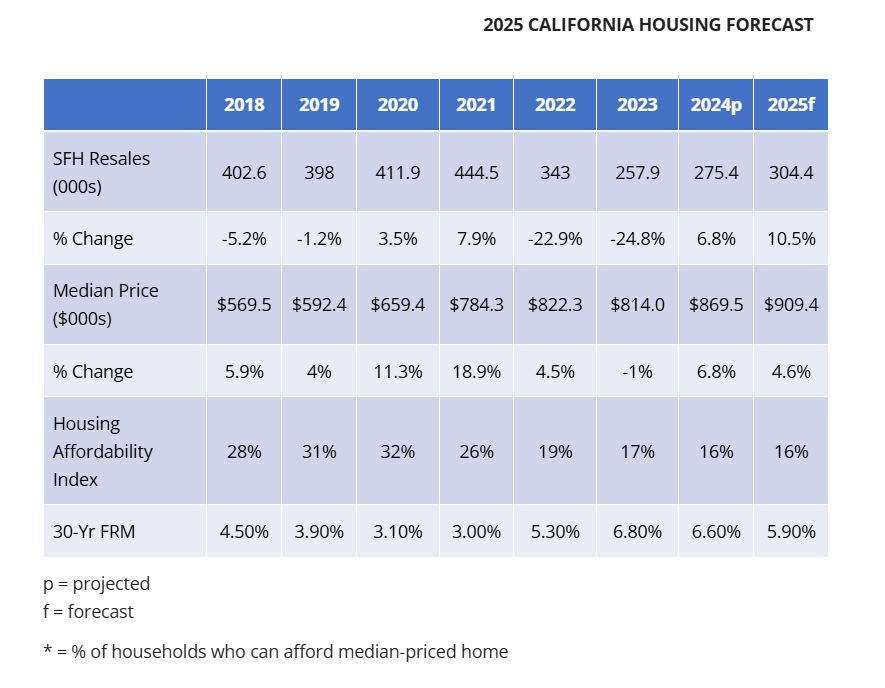
The California Association of Realtors (C.A.R.) has released its 2025 forecast, and the general consensus is optimistic. They project that existing single-family home sales will increase by 10.5% in 2025, reaching 304,400 units. This increase is a significant shift from the recent downward trends caused by high-interest rates and limited inventory.
Factors Driving the California Housing Market Forecast 2025
Several key factors are contributing to this projected growth in the California housing market:
- Lower Interest Rates: The forecast predicts that the average 30-year fixed-rate mortgage will decline from 6.6% in 2024 to 5.9% in 2025. This reduction in borrowing costs will make it easier for buyers to qualify for a mortgage and could spark increased demand. I feel it's a great opportunity for first-time homebuyers to enter the market as it will bring the rates closer to pre-pandemic levels.
- Improved Housing Inventory: Although the housing supply will still be below historical averages, there's an expectation of a moderate increase in active listings. Homeowners who were hesitant to sell due to the "lock-in effect" (when homeowners are hesitant to sell due to existing low interest rates) may be more inclined to list their homes as interest rates decrease and offer more selling flexibility.
- Returning Buyers and Sellers: The combined effect of lower interest rates and a less restrictive inventory situation will likely lead to increased activity from both buyers and sellers.
- Continued Demand: While the rate of price growth is projected to moderate, the demand for housing in California remains high. This strong demand, coupled with limited inventory, will continue to push prices upward.
The California Median Home Price Forecast
The C.A.R. forecast predicts the California median home price will increase by 4.6% to reach $909,400 in 2025. This is following a projected 6.8% increase in 2024 to $869,500 from the 2023 level of $814,000. While this signifies continued price growth, it's important to note that the pace of this growth is anticipated to be slower than in recent years.
My personal take on this is that the housing shortage will continue to impact affordability, even with the predicted increase in inventory. This continued shortage creates a competitive environment that will keep prices elevated in the majority of California's cities.
Housing Affordability: A Persistent Challenge
Housing affordability is a crucial issue for California residents, and the forecast suggests that it will remain a concern in 2025. The affordability index is projected to stay at 16%, meaning that the median-priced home is only affordable to 16% of households. It's a concern that needs to be addressed.
Economic Outlook and Impact on the California Housing Market
The California housing market is not isolated from broader economic trends. The forecast anticipates a slight slowdown in the U.S. and California economies in 2025.
- GDP Growth: The U.S. GDP is projected to slow to 1.1% in 2025, compared to 1.9% in 2024.
- Job Growth: California's nonfarm job growth is expected to decline to 1.1% in 2025 from 1.5% in 2024.
- Unemployment Rate: California's unemployment rate is anticipated to tick up to 5.6% in 2025, compared to a projected 5.4% in 2024.
However, the economic outlook is still considered relatively healthy, which should provide support to the housing market.
California Housing Market Forecast 2025: Historical Data
Here is a table that outlines the key metrics of the California housing market over the past few years and the projections for the coming years.
| Year | SFH Resales (000s) | % Change | Median Price ($000s) | % Change | Housing Affordability Index | 30-Yr FRM |
|---|---|---|---|---|---|---|
| 2018 | 402.6 | -5.2% | 569.5 | 5.9% | 28% | 4.50% |
| 2019 | 398 | -1.2% | 592.4 | 4% | 31% | 3.90% |
| 2020 | 411.9 | 3.5% | 659.4 | 11.3% | 32% | 3.10% |
| 2021 | 444.5 | 7.9% | 784.3 | 18.9% | 26% | 3.00% |
| 2022 | 343 | -22.9% | 822.3 | 4.5% | 19% | 5.30% |
| 2023 | 257.9 | -24.8% | 814.0 | -1% | 17% | 6.80% |
| 2024p | 275.4 | 6.8% | 869.5 | 6.8% | 16% | 6.60% |
| 2025f | 304.4 | 10.5% | 909.4 | 4.6% | 16% | 5.90% |
The California housing market forecast for 2025 indicates a potential rebound in both sales and prices. The projected improvement in inventory and lower interest rates is likely to attract more buyers and sellers. While the pace of price growth is expected to slow down, the underlying demand and limited supply conditions will likely continue to put upward pressure on home prices.
I believe that 2025 could present both challenges and opportunities for those looking to buy or sell in the California housing market. It's crucial to stay informed about current market conditions and to consult with real estate professionals to make well-informed decisions.
Why is the California Housing Market So Expensive?
We all know that California is the most expensive housing market in the country. Its reign as the most expensive housing market in the United States is a complex issue rooted in a confluence of factors that have built up over decades. While many point to the state's booming economy and desirable lifestyle, the reasons run far deeper.
A primary driver is the simple principle of supply and demand. California consistently ranks among the most populous states, attracting millions with its renowned climate, diverse culture, and ample job opportunities, particularly in high-paying sectors like technology and entertainment.
The state has more than 39 million residents as of 2022, constituting 11.7 percent of the U.S. population. This constant influx of new residents, coupled with a historically slow pace of housing construction, has created a significant imbalance, driving up prices as demand consistently outpaces supply.
This housing shortage is further exacerbated by stringent regulations and bureaucratic hurdles that make building new homes in California a costly and time-consuming endeavor. Zoning laws, environmental regulations, and lengthy permitting processes all contribute to delays and increased expenses for developers, costs which are ultimately passed on to buyers in the form of higher prices.
Beyond these fundamental factors, California's unique geography plays a role. Hemmed in by the Pacific Ocean to the west and mountain ranges to the east, the state faces natural limitations on its land available for development. This scarcity of buildable land, especially in desirable coastal areas, further intensifies competition and inflates prices.
Furthermore, California's robust economy, while attracting residents and driving up demand, also contributes to higher housing costs. High-paying industries and a thriving job market result in greater disposable income among residents, empowering them to afford more expensive homes and further fueling the upward pressure on prices.
This economic prosperity, while beneficial in many ways, unfortunately, creates a cycle where housing becomes increasingly inaccessible to those not earning top salaries.
Addressing California's housing crisis demands a multifaceted approach. Increasing supply through streamlined regulations and incentives for developers is crucial, as is exploring innovative housing solutions like increased density and more affordable housing options.
What to Expect in the California Housing Market in 2025?
1. Mortgage Rates Will Play a Key Role
- The recent dip in interest rates has been a breath of fresh air for buyers.
- While no one can predict the future with certainty, most experts believe rates will remain relatively stable for the rest of the year, hovering around the 6-7% range.
- This could incentivize more buyers to enter the market, especially if prices continue to moderate.
2. Inventory Will (Slowly) Improve
- The increase in active and new listings is a positive sign.
- However, don't expect a sudden surge in inventory. California has a chronic undersupply of housing, and it will take time to bridge the gap.
3. Price Growth Will Continue, But at a Slower Pace
- Double-digit price appreciation is likely a thing of the past (for now, at least).
- Most analysts predict more sustainable, single-digit price growth for 2025.
- Don't expect a crash – the fundamentals of the California economy remain strong, supporting continued demand for housing.
4. Regional Variations Will Persist
- As always, California's vastness means there's no one-size-fits-all trend.
- The Bay Area, with its robust tech sector, will likely continue to see strong demand, even with some cooling.
- Coastal communities, highly desirable for their lifestyle, will also remain competitive.
Factors Impacting the California Housing Market
Several factors have contributed to the challenges facing the California housing market. Here are some key factors that interact with each other, creating a complex and dynamic housing market in California.
1. High Demand and Limited Supply:
California has a high population density and strong economic growth, leading to a high demand for housing. However, there is a limited supply of available housing, particularly in desirable areas. This imbalance between supply and demand has driven up housing prices, making it difficult for many prospective buyers to afford homes.
2. Affordability Issues:
The high cost of housing in California has made homeownership less attainable for many residents. The median home price in the state is significantly higher than the national average. The combination of high home prices, rising interest rates, and stringent mortgage qualification rules has created affordability challenges for prospective buyers.
3. Strict Zoning and Land Use Regulations:
California has some of the most stringent zoning and land use regulations in the country. These regulations often restrict new construction and development, making it difficult to increase the housing supply to meet demand. This has resulted in a housing shortage and contributed to the rising prices.
4. Lack of Affordable Housing:
California faces a severe shortage of affordable housing, particularly in major cities. The cost of constructing affordable housing and the complex process of obtaining approvals and permits have hindered the development of affordable units. This has exacerbated the affordability crisis and led to a growing population of renters.
5. Economic Factors:
Economic conditions, such as job growth, wages, and interest rates, can significantly impact the housing market. Slowing economic growth or stagnant wages can dampen demand for housing, while rising interest rates can increase borrowing costs and dissuade potential buyers. These factors, in combination with high housing prices, have made it challenging for many Californians to enter the housing market.
6. Impact of Natural Disasters:
California is prone to natural disasters, including wildfires and earthquakes, which can damage or destroy homes and disrupt the housing market. Rebuilding efforts and insurance costs following these events can impact housing availability and affordability in affected areas.
7. Migration Patterns:
Migration patterns also play a role in the housing market. California has experienced both domestic and international migration, leading to increased demand for housing. However, in recent years, there has been a trend of net outmigration, with some residents leaving the state due to affordability concerns, congestion, and other factors. This can impact the supply and demand dynamics of the housing market.
Should You Buy a House in California in 2025?
California's sunshine and laid-back lifestyle lock in many a homebuyer's sights. But is it a smart investment right now? Let's crunch the numbers and explore the current California housing market to help you decide if this is the golden moment to make your move.
Market on the Move: Boom or Bust?
California's housing market has a well-deserved reputation for soaring prices. The past decade has seen impressive appreciation, with some areas experiencing double-digit growth. However, the recent quarters have shown a shift. The breakneck pace has cooled, with some regions even experiencing slight dips. This could be a sign of a long-awaited correction or simply a temporary adjustment.
Numbers to Know: Crunch Time
So, what do the numbers tell us? Here's a reality check: while the recent price hikes may have eased, California homes are still expensive. The statewide median price recently hit a record high of over $900,000. Couple that with rising interest rates, and monthly mortgage payments can feel like a hefty weight on your wallet.
Beyond the Numbers: Considering Your Needs
The decision to buy a house in California goes beyond cold, hard numbers. It's about your long-term goals and financial health. Here are some key questions to ask yourself:
- Are you in it for the long haul? California real estate has historically been a good long-term investment. If you plan to stay put for at least five to seven years, you'll weather any market fluctuations and likely see your home value appreciate.
- Can you handle the upfront costs? Don't forget about the down payment, closing costs, and potential repairs. Having a healthy financial buffer will ease the initial strain.
- Is your job stable? Job security is crucial, especially in a state with a higher cost of living.
A Competitive Market: Be Prepared
California's housing market is competitive, especially in desirable locations. Inventory remains tight, so be prepared to act fast and make competitive offers. Having a strong pre-approval from a reputable lender will put you ahead of the pack.
The California housing market has its complexities. Teaming up with a qualified real estate agent who understands the local market nuances is wise. They can guide you through the process, negotiate on your behalf, and help you find the perfect place that fits your budget and lifestyle.
The Verdict: It Depends
There's no one-size-fits-all answer to the California housing question. If you've done your research, understand the market conditions, and are financially prepared, buying a house in California could be a great decision. But remember, it's a significant investment, and it's wise to approach it with both eyes open.