

Posts from December 2024

Sunshine Properties Blog

Subscribe and receive email notifications of new blog posts.


rss logo RSS Feed
Uncategorized | 818 Posts
December
9

San Diego avocado growers concerned over USDA ending import inspections

The agency said its is handing pest inspections of Mexican orchards over to the Mexican government because of threats of violence against USDA inspectors.

San Diego avocado growers are concerned about increased pest threats to their crops now that the U.S. Department of Agriculture (USDA) won't be inspecting Mexican imports.

The USDA announced the change last month, saying it is handing over pest inspections to the Mexican government because of threats of violence against its inspectors. The USDA did not respond to an email seeking comment.

In a statement, Mexico's Agriculture Department said that with the agreement, the USDA is "recognizing the commitment of Mexican growers, who have not had any sanitary problems in exports for more than 27 years."

Advertisement

But U.S. growers are concerned.

"That decision was made unilaterally, without any consultation of our domestic growers," said Jason Cole, chair of the California Avocado Commission.

He's worried that Mexican inspectors won't be as rigorous as the USDA's.

"The bugs that are down there are some of the worst ones when it comes to avocado pests," Cole said. "So it would be devastating to our growers if they were to get through."

There has been trouble in the past. Infected avocados from Mexico in the '90s introduced persea mites to San Diego. The mites eat through the leaves, causing them to fall off, exposing and sun-bleaching the fruits.

Advertisement

Robert Jackson owns avocado orchards in Bonsall and Escondido. He showed us an example of avocados damaged by persea mites.
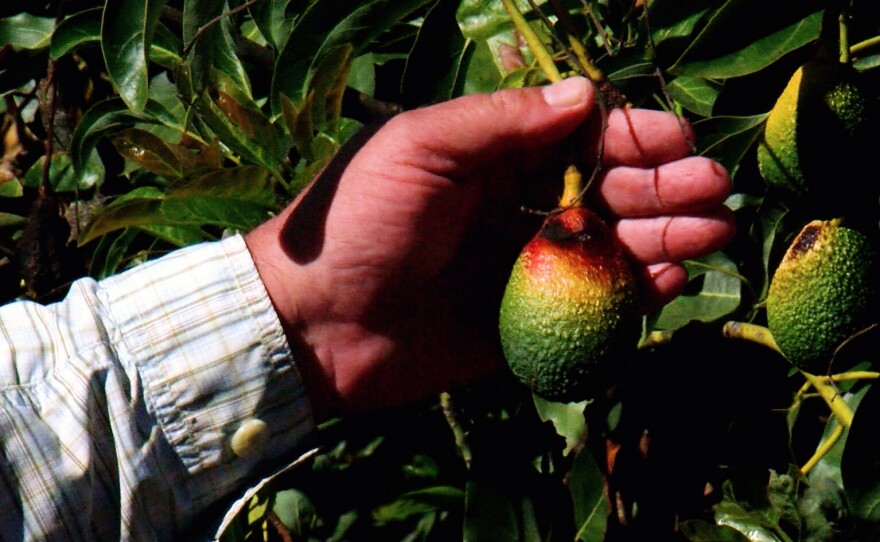
Robert Jackson showing off a sun-bleached avocado from a tree infected by persea mites in his orchard in Valley Center, Oct. 15, 2024.
/
KPBS
Robert Jackson showing off a sun-bleached avocado from a tree infected by persea mites in his orchard in Valley Center, Oct. 15, 2024.

"That type of fruit right there is not marketable," he said, pointing to a sun-bleached avocado in his orchard.

Jackson said having U.S. officials do the inspections was to protect California growers and allow Mexico to import avocados.

"We had in the last three years, two different shutdowns of the system where Mexico was stopped from importing avocados into the U.S. for a period of time because they were threatening the U.S. inspectors," he said. 

The latest shutdown was in 2022, when an inspector and his family were threatened, according to the USDA. In June, the U.S. temporarily suspended avocado inspections because of security concerns.

Avocados from Mexico on sale at Trader Joe's in Liberty Station, Oct. 17, 2024.

Since 1997, inspectors hired by the USDA's Animal and Plant Health Inspection Service (APHIS) have been guarding against avocados infected with pests and diseases. They have also been threatened for refusing to certify shipments containing avocados from non-certified states.

Only two Mexican states are certified to import to the U.S. — Michoacán and Jalisco.

In an open letter to U.S. Secretary of Agriculture Tom Vilsack, the Avocado Commission demanded to know how using Mexican inspectors would be in the "best interest" of U.S. growers.
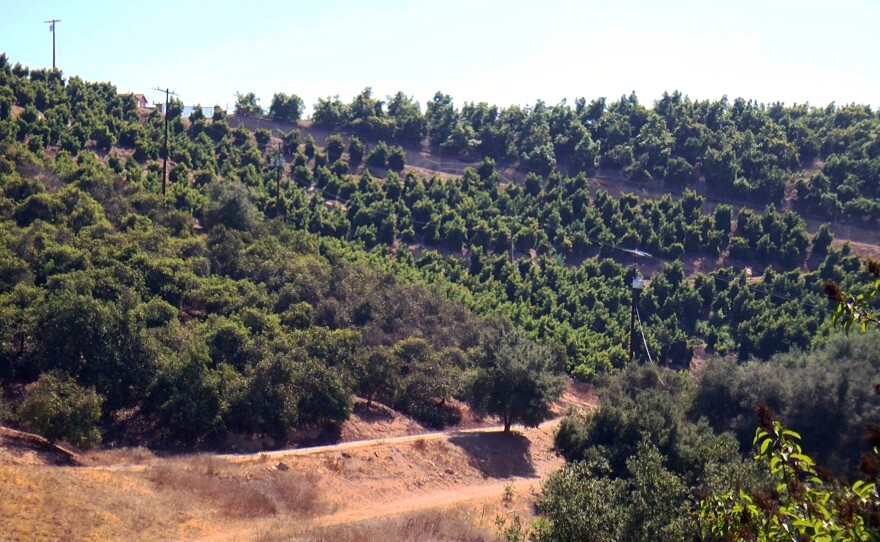
Ridge Creek Ranch avocado orchard in Valley Center, Calif., part of the Avocado High in San Diego County, Oct. 15, 2024.
/
KPBS
Ridge Creek Ranch avocado orchard in Valley Center, Calif., part of the Avocado High in San Diego County, Oct. 15, 2024.

According to the county's latest crop report, avocado was one of San Diego's top 10 crops, bringing in nearly $100 million last year.

The USDA's decision could have implications beyond avocados. San Diego County Farm Bureau president Dana Groot said it sets a bad precedent for other imported crops.

"The problem is San Diego County, and even California, will lose some degree of sovereignty, or local control, over food supply," he said.

He said it's a national concern if the domestic food supply is lost.

About 80% of avocados sold in the U.S. come from Mexico. Domestic growers are not able to meet demand or provide the fruit year-round.

Article belongs to 

December
9

Over the weekend, the U.S. Department of Justice (DOJ) filed a "Statement of Interest" related to NAR's proposed settlement of claims regarding broker commissions. Based on their dialogue with the DOJ over the course of this year, NAR had expected this possibility.

In its statement, the DOJ raised concerns about the requirement that MLS Participants must enter a written buyer agreement when they are working with buyers prior to touring a home. A new California law requires buyers and their brokers to enter into written agreements, so the DOJ's concerns should not have much impact in California.

The DOJ is not a party to the settlement agreement or a class member. The Court may consider the DOJ's perspective alongside the other arguments made by objectors and will decide whether to grant final approval soon.

NAR will continue to advocate for final approval in the lead-up to and at the Nov. 26 hearing.

Nov. 25, 2024

Click Here to Read More...

December
3

Click Here to Read More...

December
3

  • 30-year fixed rate6.91% interest rate and 6.96% APR 

Click Here to Read More...

December
3

The Federal Housing Finance Agency (FHFA) today announced the conforming loan limit values for mortgages acquired by Fannie Mae and Freddie Mac (the Enterprises) in 2025. The conforming loan limit is $806,500 on one-unit properties and a cap of $1,209,750 in high-cost areas. The previous loan limits were $766,550 and $1,149,825, respectively.

The conforming loan limit determines the maximum size of a mortgage that government-sponsored enterprises (GSEs) Fannie Mae and Freddie Mac can buy or "guarantee." Non-conforming or "jumbo loans" typically have tighter underwriting standards and sometimes carry higher mortgage interest rates than conforming loans, increasing monthly payments and hampering the ability of families in California to purchase homes by making them less affordable.

C.A.R. and NAR both have long advocated for loan limits that reflect an area's cost of housing. As a result of C.A.R.'s and NAR's efforts, areas with high me...

Click Here to Read More...

⇦ Newer Posts

Login to My Homefinder

Pixel