

Posts from June 2022

Sunshine Properties Blog

Subscribe and receive email notifications of new blog posts.


rss logo RSS Feed
Uncategorized | 818 Posts
June
24


June 20, 2022 – Recent data suggests that inflation is becoming increasingly entrenched in the economy. High inflation is eroding real income and will weigh on consumer spending growth in coming quarters. In an attempt to keep inflation under control, the Federal Reserve has become more hawkish. The Federal Open Market Committee (FOMC) has already raised its target range for the federal funds rate to 150 basis points since March and we can expect more rate hikes this year and next year. While the underlying fundamentals remain solid so far, there is no doubt that an economic slowdown is forthcoming in the next few quarters. The question remains whether the Fed's newfound aggressiveness will ultimately lead to a recession or just a soft landing.

Fed hikes its benchmark interest rate by 0.75 percentage point, the biggest increase since 1994: In an effort to combat inflation, the Federal Open Market Committee (FOMC) raised their target federal funds rate by 75 basis points last week to a range of 1.5%-1.75%, the highest range level since just before the Covid pandemic began in March 2020. The hopes are that demand can be tamed down so that supply can catch up. The economy could experience a period of slower growth during the process, however. The financial markets have been volatile, as a result, as an increasing number of market participants have been anticipating an upcoming recession in the coming quarters.

Mortgage rates surge 50 basis points week-to-week, the largest one-week since 1987: Not only have the financial markets reacted unfavorably to the Fed's latest decision to raise their benchmark interest rate, but lenders also adjusted promptly to the heightened aggressiveness of the Fed in combating the relentless inflation. According to Freddie Mac's Primary Mortgage Market Survey (PMMS), the 30-year fixed-rate mortgage (FRM) averaged 5.78% and increased more than 50 basis points from the week prior and represented the largest one-week increase in more than 3 decades. Higher mortgage rates will lead to more moderations in housing activity while easing price growth, as the market find more balance between supply and demand.

Housing starts decline sharply in May: Total housing starts dropped 14.4% during May, bringing the total housing starts to a 1.549-million-unit pace, a relatively strong pace but also the slowest since April 2021. Single-family starts declined for the third consecutive month at 9.2% but were up 3.2% year-to-date. The residential sector has been hit hard by a sharp increase in mortgage rates over the past few months. Higher borrowing cost as home prices continue to rise at a fast pace have put a major dent in new home sales, which may have caused home builders to scale back their production in the latest month.

Wholesale prices rise 10.8% in May, near a record annual pace: In May, the Producer Price Index (PPI) rose 0.8% from April and was slightly off the record 11.5% annual pace registered earlier this year. As high prices remain the number one threat to the stability of the economy, the Federal Reserve will continue watching inflation numbers closely and maintain their aggressive monetary policy strategy like they announced in their latest meeting.

Small businesses are showing strains and resilience at the same time: The NFIB Small Business Optimism Index fell 0.1 point to 93.1 in May. The index has been running below its 48-year average of 98 every month this year, although May's reading remained consistent with modest economic growth. While the overall index is holding up relatively well, small business owners have front row seats to price hikes and are coming under pressure from rising input and compensation costs as demand slows. This results in business owners remaining concerned about the economic outlook and their operating margins. That said, a growing number of business owners were still planning to add staff and a record number reported that they currently still have job openings yet to fill.

article belongs to CAR.ORG

June
21

DID YOU KNOW?

Although classified as a vegetable in the USDA database based on common usage, avocados are considered a fruit because they fit the botanical criteria for a berry thanks to their fleshy pulp and large seed. More specifically, the avocado is a fruit that belongs to the genus Persea in the Lauracaea family. This refers to the type of tree and flowering plant. 

Avocados were once a luxury food reserved for the tables of royalty, but now avocados are enjoyed around the world by people from all walks of life.

The easiest and safest way to remove the avocado seed is to quarter the avocado

  • Carefully cut the avocado in half length-wise around the seed, with the fruit flat on the cutting board
  • Rotate the avocado ¼ turn and cut length-wise around the seed, creating...

Click Here to Read More...

June
21

FEATURE CALIFORNIA AVOCADOS ON SPRING MENUS

  • Jun 14, 2022

A trio of California-based restaurant chains is promoting California avocados on their spring menus from April through June, building awareness of the fruit while it is in season. The promotions feature the California Avocados brand logo on the chains' websites, unique email blasts, California avocado merchandise giveaways, and social posts on LinkedIn, Instagram and Facebook.

From April 14 – June 8, Del Taco units in Arizona, California, Nevada, New Mexico, Oregon, Utah and Washington celebrated California avocado season. In total, 511 units of the 595 Del Taco locations in the United States showcased California avocados and house-made guacamole.

In Northern California, all 14 Super Duper units in the Bay Area featured the Golden State fruit from Apri...

Click Here to Read More...

June
21

Economists at Fannie Mae have dramatically downgraded their home sales forecasts for this year and next, saying they expect a "modest recession" in the second half of next year in the face of Fed tightening and the war in Ukraine.

In their latest forecast Tuesday, Fannie Mae economists said the projected downturn "is not expected to resemble the severity or duration of the Great Recession," but that higher mortgage rates are likely to cause home sales to decline by 7.4 percent this year and by 9.7 percent in 2023.

Fannie Mae had previously forecast that home sales would drop by 4.1 percent this year and 2.7 percent next year.

"Since our last forecast, monetary policy guidance has shifted in a hawkish direction, and markets have responded with rapid increases in interest rates, signaling a belief that brisker tightening is likely to occur," Fannie Mae forecasters said. "While a 'soft landing' for the economy is possible, which is where inflation subsides without economic contraction, historically such an outcome is an exception, not the norm."

If there is a recession, Fannie Mae economists don't expect it will be as severe or as long as the Great Recession of 2007-09, due to "multiple factors."

Advertisement
Advertisement

Source: Fannie Mae Housing Forecast, April 2022.

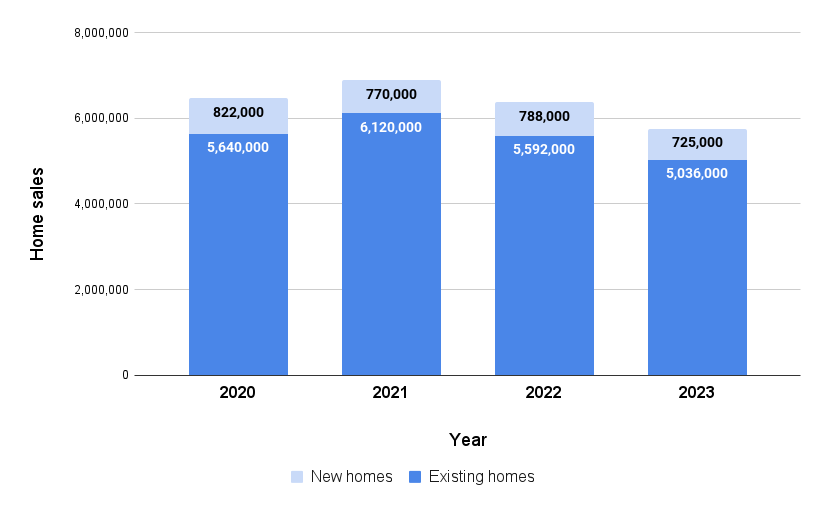
Shortages of existing homes have builders working overtime to complete new houses, and Fannie Mae still sees new home sales growing by 2.3 percent this year, to 788,000 homes, even with sales of existing homes projected to drop by 8.6 percent, to 5.6 million.

But the "lock-in" effect of rising mortgage rates and worsening affordability "will eventually weigh on new sales as well," Fannie Mae economists said of their prediction that sales of new homes will drop by 8 percent in 2023, to 725,000.

"The most recent reading of homebuilders' sentiment showed continued strong current expectations for sales, but the index fell sharply for the six-month outlook. While the level was still elevated, indicating good market conditions, the change was one of the largest in series history."

Home price appreciation may also cool
Featured Inman Insider Webinars

Website Wins: How to Turn Your Visitors into VictoriesWatch now
How it works: Interactive Storytelling with AIWatch now
Let's talk data: leverage the 'secret' tool of Fortune 100sRegister
The new landscape of financing: what you need knowWatch now

Source: Fannie Mae Housing Forecast, April 2022.

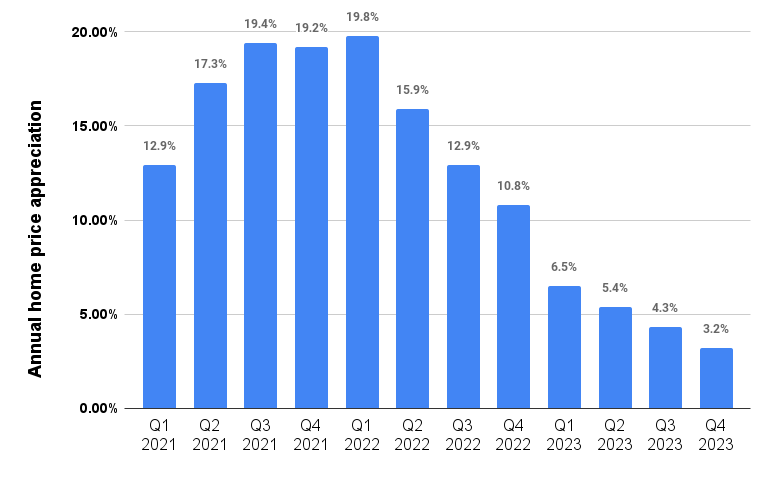
For would-be homebuyers being priced out of the market, the good news is that Fannie Mae economists expect home price appreciation to make a rapid plunge back to the single digits, moderating from a record 19.8 percent during the first quarter of this year to 6.5 percent by the first quarter of 2023 and 3.2 percent by the final three months of next year.

End of the refi boom
Advertisement

Source: Fannie Mae Housing Forecast, April 2022.

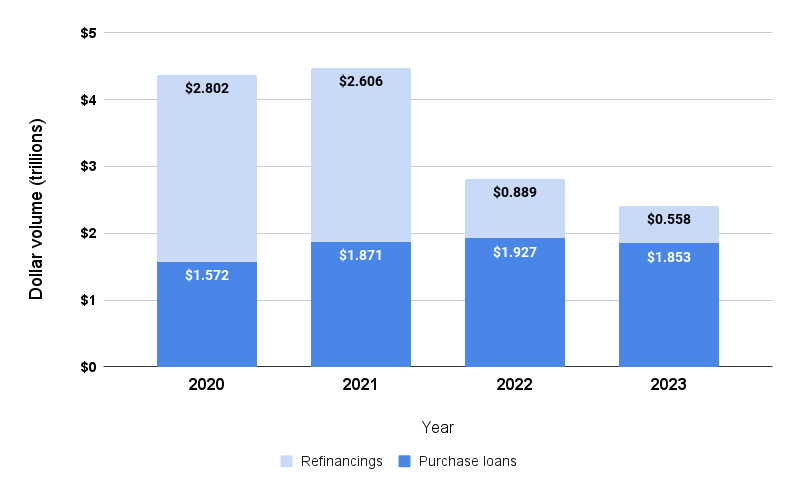
Fannie Mae now forecasts single-family mortgage originations will total $2.8 trillion in 2022 and $2.4 trillion in 2023, down from previous forecasts of $3 trillion and $2.7 trillion, respectively.

The prospect that rising mortgage rates will dent home sales prompted Fannie Mae to lower its forecast for 2022 purchase volume by $18 billion, to $1.93 trillion, and by $130 billion in 2023, to $1.85 trillion.

Given the recent run-up in mortgage rates, Fannie Mae now expects $889 billion in refinance volumes in 2022, $148 billion lower than forecast last month.
With mortgage rates at 5.0 percent, just 2.3 percent of all outstanding loan balances have a refinance rate incentive of at least 50 basis points.

"It should be noted that interest rates have moved up further than we had expected since the completion of our interest rate forecast at the start of the month, representing downside risks to our housing forecast," Fannie Mae economists said.

Get Inman's Extra Credit Newsletter delivered right to your inbox. A weekly roundup of all the biggest news in the world of mortgages and closings delivered every Wednesday. Click here to subscribe.

June
14

Fannie Mae introduces Refinance Application-Level Index

RALI provides dollar volume measure of unpaid principal balance and loan count measure

Click Here to Read More...

⇦ Newer PostsOlder Posts ⇨

Login to My Homefinder

Pixel