

Sunshine Properties Blog

Sunshine Properties Blog

Subscribe and receive email notifications of new blog posts.


rss logo RSS Feed
Uncategorized | 851 Posts
June
15

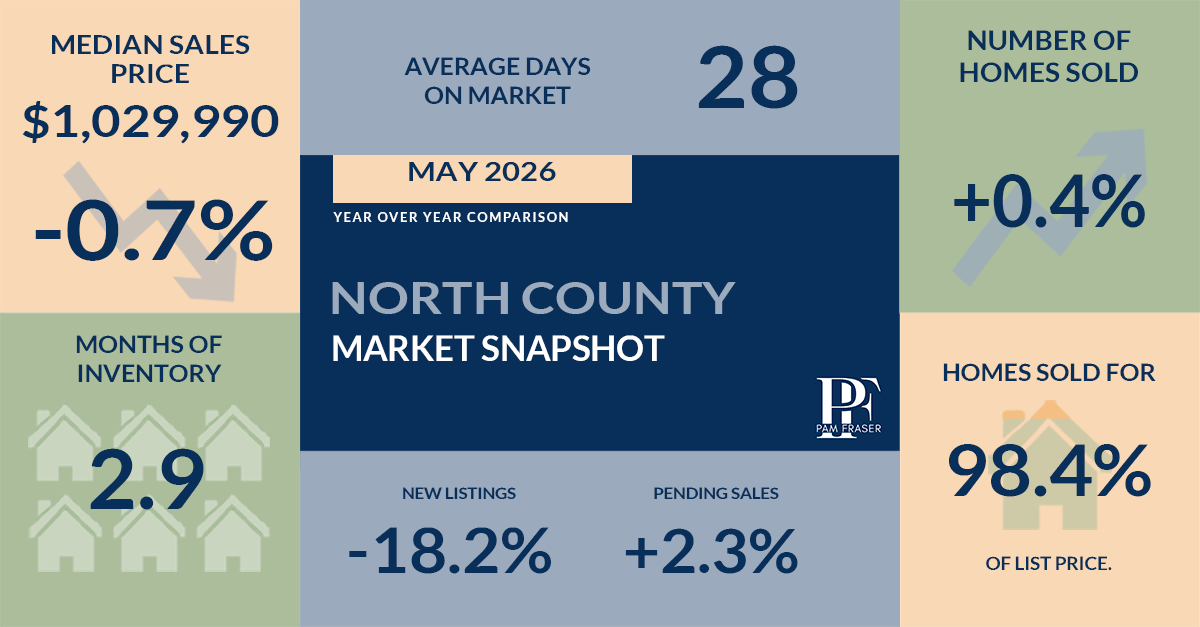
North San Diego County housing market statistics for May 2026 including median price, homes sold, days on market and inventory

North County and San Diego Housing Markets June 2026

May numbers show the San Diego and North County housing markets continuing the same pattern we've seen throughout the spring. Inventory remains limited, prices are holding steady, and higher mortgage rates have not yet had a significant impact on local housing activity.

Altos Research continues to classify single-family homes as a strong seller's market while condos remain in slight seller's territory. At the higher end of the market, pending sales of multimillion-dollar homes increased in May, according to a recent San Diego Union-Tribune report.

The countywide median sales price was $925,000 in May, exactly the same as it was two years ago. In North County, the median price was $1,029,990, slightly below both May 2024 and April 2026 levels. Although inventory is higher than it was two years ago, it remains below long-term norms. With supply still limited, prices have remained remarkably stable despite higher mortgage rates and concerns about inflation.

Below are answers to some of the most common questions about current market conditions.

San Diego Housing Market FAQs

Are home prices rising in San Diego County?

Countywide, the median home price was $925,000 in May. That is exactly where prices were two years ago. In North County, the median price was $1,029,990, lower than May 2024 and slightly below April's level.

What is happening with inventory?

Inventory remains limited. Active listings are down 12.4 percent year over year countywide and nearly 30 percent in North County. Supply increased slightly month over month but remains below long-term norms.

Are homes taking longer to sell?

No. Countywide days on market remained at 33 days, unchanged from one year ago. In North County, days on market increased slightly from 26 to 28 days.

Are sales increasing?

Sales activity remains relatively stable. The number of homes sold was very close to last year's level, reflecting both limited inventory and many buyers remaining on the sidelines.

Is this still a seller's market?

Yes. Altos Research continues to classify single-family homes as a strong seller's market, while condos remain in slight seller's territory. Limited supply continues to support pricing, though buyers remain selective.

Looking for more detail or wondering what your home is worth in today's market? Request a free home valuation.

Interest Rates

Below are current mortgage rate averages and recent changes, updated regularly.

Market Updates

Click on the links below to read the San Diego real estate market reports.


North County Housing Summary

Here's how the North County market performed compared to last year.

  • Median home prices declined 0.7 percent.
  • Detached home prices decreased 9.5 percent, from $1,248,997 to $1,130,000.
  • Sold units increased 0.4 percent. Pending sales grew 2.3 percent.
  • Median days on market increased to 28, up 7.7 percent from last year.
  • Months of inventory decreased from 4.9 months to 2.9 months.


San Diego County Housing Summary

Here are the numbers for San Diego County.

  • Median prices rose 1.3 percent, from $913,500 to $925,000.
  • Detached home prices were unchanged at $1,099,500.
  • Attached home prices decreased 1.5 percent to $675,000.
  • Months of inventory decreased from 3.5 months to 3.0 months.
June
15

SDAR Applauds Defeat of Measure A, Calling Vote a Victory for Homeowners and Property Rights

June 4, 2026

San Diego, CA — June 4, 2026 — The San Diego Association of REALTORS® (SDAR) today applauded the defeat of Measure A, the City of San Diego's proposed residential vacancy tax, calling the outcome a victory for homeowners, property rights, and sound housing policy. Based on unofficial election returns, San Diego voters rejected Measure A by a significant margin.


Throughout the campaign, SDAR and a broad coalition of housing advocates, homeowners, taxpayers, small businesses, and housing providers raised serious concerns about Measure A's potential consequences, including:


No guaranteed housing outcome: Measure A did not guarantee lower rents, new affordable housing, or a dedicated housing fund.
 

New costs on property owners: Mea...

Click Here to Read More...

June
8

AI is creating new challenges, opportunities and questions about the industry's future

Plus, Compass faces an antitrust probe, the dark side of South Florida's branded condos and more national real estate news this week

Jun 7, 2026, 6:00 AM PDT

Artificial intelligence is quickly becoming one of real estate's most important customers.

It's leasing offices, fueling data center development and helping drive some of the strongest pockets of demand the...

Click Here to Read More...

June
8

Can you buy a home with Anthropic stock — and see tax benefits? Here's the reality

By ,Contributor

Click Here to Read More...

June
2

Current mortgage interest rates in California

As of Tuesday, June 02, 2026, current interest rates in California are 6.63% for a 30-year fixed mortgage and 6.00% for a 15-year fixed mortgage

Mortgage rates in California — and throughout the country — peaked near 8 percent in late 2023 and have decreased since, but not as quickly as many prospective homebuyers were hoping. While rates have fallen further in recent months due to economic uncertainty, experts expect them to remain between 6 and 7 percent for the rest of the year, settling closer to 6.5 percent as 2025 ends.

Refinance rates in California

Refinance rates are looking much more attractive these days, especially if you bought your home a few years ago, when rates were higher. According to property data provider ATTOM, the number of refinance loans in the Golden State increased by 1.3 percent year-over-year between August 2024 and August 2025. 

Refinancing now could help you lock in a lower rate, and if you have a large chunk of equity — either because you've owned for a long time or because your home value has increased — you may be able to benefit from a cash-out refinance. This lets you turn some of your home's equity into cash, which you can use for home improvements, education or other financial goals. Almost half of California homeowners are equity rich — that is, they own more than 50 percent of their homes — according to ATTOM. 

National mortgage rates by loan type

Product Interest Rate APR
6.54% 6.61%
5.90% 5.99%
6.41% 6.46%
6.57% 6.62%
6.66% 6.70%
5.77% 6.38%
5.94% 6.29%
Product Interest Rate APR

Rates as of Tuesday, June 02, 2026 at 6:30 AM

California housing market statistics and trends

While California is a notoriously expensive place to purchase a home, there are more affordable pockets of the state, and the median sale price only grew nominally in October (up 0.06 percent over last year at the same time). Homes are also remaining on the market a median of 10 days longer year-over-year in October, and the percentage of homes with price drops increased by 3 percent. So while California can still be a tough place to buy, there are positive signs. 

  • Median home sales price, Sept. 2025: $744,000
  • Median home value, Sept. 2025: $773,750
  • Median down payment, Sept. 2025: $156,000
  • Median days on market, Oct. 2025: 47
  • Percentage of homes sold above list price, Oct. 2025: 33.8%
  • Percentage of homes with price drops, Oct. 2025: 28.6%
  • Homeownership rate, Q2 2025: 55.3%

Sources: Redfin, ATTOM, U.S. Census Bureau

No matter where you're looking to buy, don't just look at the list prices: Compare homeowners insurance options, too, since the state has struggled to keep major carriers in the wake of recent natural disasters.

Mortgage options in California

  • California conventional mortgages: To qualify for a conventional mortgage, you'll generally need a credit score of at least 620 and a debt-to-income (DTI) ratio of no more than 43 percent. In many cases, you can find down payments as low as 3 percent — though if you put down less than 20 percent, you will need to pay for private mortgage insurance (PMI).  
  • CalHFA: The California Housing Finance Agency (CalHFA) offers state residents access to mortgages, as well as smaller loans designed to help with down payment or closing costs. To get started, borrowers can contact a CalHFA-approved lender or preferred loan officer.
  • California FHA loans: Home loans backed by the Federal Housing Administration (FHA) are offered throughout the U.S. While the FHA doesn't offer loans directly, you can find one through an FHA-approved lender in California. FHA loans are generally designed for low- to moderate-income borrowers with lower credit scores.
  • California VA loans: Guaranteed by the Department of Veterans Affairs, VA loans are offered to eligible veterans and active-duty service members. While the VA doesn't offer loans directly, you can find one through a VA-approved lender in California. VA loan interest rates are typically lower than conventional mortgages, and these loans usually require no down payment.
  • California jumbo loans: You'll find higher conforming loan limits in many of California's pricier zip codes, but you may still need to borrow even more money to make homeownership a reality in the state. If you do, you'll need to compare jumbo loan rates from multiple lenders and be prepared to meet higher down payment and credit score requirements.

First-time homebuyer programs in California

Buying a house in California can be pricey, but first-time homebuyers might qualify for grants or other forms of help. This includes:

  • CalHFA down payment assistance programs: Low- to moderate-income borrowers can apply for small down-payment and closing-cost assistance loans through CalHFA. One option is the MyHome Assistance program, which allows you to borrow a deferred loan worth up to 3.5 percent of the purchase price or appraised value for a government loan and up to 3 percent with a conventional loan.
  • CalHFA Loan Programs: With the CalHFA Conventional Loan Program, you can get a 30-year, fixed-rate conventional loan, potentially at a more affordable interest rate, but you'll also need to meet qualification requirements. The CalPLUS Conventional Loan Program is similar, but with a slightly higher interest rate. These loans can be combined with the CalHFA Zero Interest Program to help pay closing costs. CalHFA also offers lower rate FHA, VA and USDA loans, which come with their own benefits and qualifying criteria.

In addition to statewide assistance programs, be sure to compare local options. Some local organizations offer loans and grants to certain types of buyers, including first-time buyers and low- to moderate-income families.

⇦ Newer PostsOlder Posts ⇨

Login to My Homefinder

Pixel